
Ask any seasoned contractor about the number one reason renovations go sideways, and you will hear the same answer: unrealistic expectations. A home renovation is a complex logistical operation involving multiple trades, material lead times, permitting cycles, and inspection schedules. The timeline that lives in a homeowner’s imagination rarely survives contact with reality. The good news is that a well-constructed timeline is not guesswork. It is a planning discipline built on structured phases, honest buffers, and documented dependencies.
This guide breaks down the methodology professionals use to build renovation schedules that hold up under pressure.
Start With Scope, Not Dates
Many homeowners begin by picking a start date and working forward. This is the wrong sequence. Before a single date is set, the scope of work must be defined in writing. Every schedule error downstream traces back to an undefined task.
- Inventory the work: List every room, system, and finish affected by the project.
- Separate structural from cosmetic: Structural changes drive permits, inspections, and schedule risk.
- Define finishes early: Tile, cabinetry, and fixtures have lead times measured in weeks, not days.
- Document exclusions: Write down what is not included so expectations stay aligned.
A clear scope becomes the foundation for every task, duration, and dependency that follows.
Break the Project Into Standard Renovation Phases
Nearly every renovation follows the same broad sequence. Understanding these phases helps you estimate durations accurately and anticipate where the schedule will compress or expand.
These ranges assume normal conditions. Custom work, historic homes, and supply-constrained materials push every phase toward the upper bound.
Map Dependencies Before You Assign Durations
A renovation schedule is a network of dependencies, not a simple list. Drywall cannot be hung until rough-in inspections pass. Cabinets cannot be installed until flooring is complete in many layouts. Mapping these relationships prevents the most common scheduling failure: assigning tasks in parallel that must run in sequence.
Critical Path Thinking
Identify the longest chain of dependent tasks. This is your critical path, and it determines the project’s minimum duration. Any delay on the critical path delays the entire renovation. For most projects, the critical path runs through permitting, rough-in, and inspection cycles.
Parallel Work Opportunities
While the critical path advances, other work can proceed in parallel. Material procurement, for example, should begin during permitting rather than after demolition. Identifying these overlaps is where experienced project managers recover weeks.
Build Buffers Into Every Phase
A timeline without buffers is a wish list. Industry practice uses two buffer types:
- Task-level buffers: Add 10 to 20 percent to individual durations for weather, trade availability, and minor surprises.
- Project-level buffer: Reserve a consolidated contingency of 10 to 15 percent of total duration for unknowns.
Buffers are not padding. They are risk management, and they should be visible in the schedule so everyone understands where slack exists.
Estimate Durations Using Historical Data
Professional estimators build timelines from documented experience, not intuition. Use the following baseline table as a starting reference for common renovation scopes.
| Bathroom remodel | 4 to 8 weeks | Plumbing surprises, tile lead times |
| Kitchen remodel | 8 to 16 weeks | Cabinetry lead times, appliance availability |
| Basement finishing | 6 to 12 weeks | Permitting, egress requirements |
| Full-home renovation | 6 to 12 months | Structural work, phased inspections |
| Addition | 4 to 8 months | Foundation work, weather, inspections |
Adjust these baselines using data from comparable projects, your contractor’s past schedules, and local permitting timelines.
Account for Material Lead Times Early
Supply chain realities are now a permanent scheduling factor. Cabinetry, windows, custom doors, and specialty fixtures routinely carry lead times of eight to twenty weeks. Ordering these items during the design phase, not after demolition, prevents the most painful renovation stall: a finished room waiting on a single backordered component.
Action item: Build a procurement schedule alongside the construction schedule. Every long-lead item gets an order date and a delivery date tied to the install phase.
Schedule Inspections Explicitly
Inspections are appointments with external agencies, and they consume calendar time. Rough-in inspections, framing inspections, and final sign-offs should appear as discrete line items in the schedule with realistic wait times. In busy jurisdictions, inspection scheduling alone can add one to two weeks per cycle.
Choose the Right Scheduling Tool
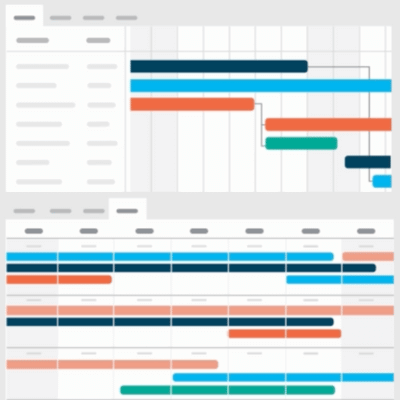
For small projects, a spreadsheet with columns for task, duration, dependency, start date, and finish date is entirely sufficient. For larger renovations, Gantt chart tools make dependencies visible and allow rapid recalculation when a task slips. The tool matters less than the discipline of updating the schedule weekly and communicating changes to every trade.
Plan Weekly Reviews and Course Corrections
A schedule is a living document. Hold a short weekly review with the contractor to compare planned progress against actual progress. When a task slips, immediately assess whether it sits on the critical path. If it does, compress downstream tasks, reallocate labor, or release a portion of the project buffer. Early correction keeps small delays from compounding into months.
Communicate the Timeline to All Stakeholders
An unshared schedule is an unenforced schedule. Distribute the current timeline to the contractor, subcontractors, and family members affected by the disruption. Make sure everyone knows the milestone dates, the inspection windows, and the decision deadlines for selections. Clear communication reduces change orders, which are among the leading causes of renovation delays.
Final Thoughts
A realistic renovation timeline is built in a specific order: define scope, break the work into phases, map dependencies, estimate with data, add buffers, and review continuously. Homeowners who follow this discipline consistently experience fewer surprises, better trade relationships, and projects that finish close to plan. The schedule will never be perfect, but a structured one will always outperform an optimistic guess.